Sustainability reporting has arrived faster than the systems to manage it.
What started as a voluntary exercise in corporate social responsibility has turned into a complex data-gathering mission. Compiling a single report often involves weeks of chasing invoices and manually calculating emissions, only to find the requirements have shifted again by the time the data is ready.
The new Odoo ESG app changes that by connecting sustainability metrics directly to day-to-day operations.
Designed to align with new laws like the EU’s Corporate Sustainability Reporting Directive (CSRD), it turns sustainability reporting into an automated, ongoing process.
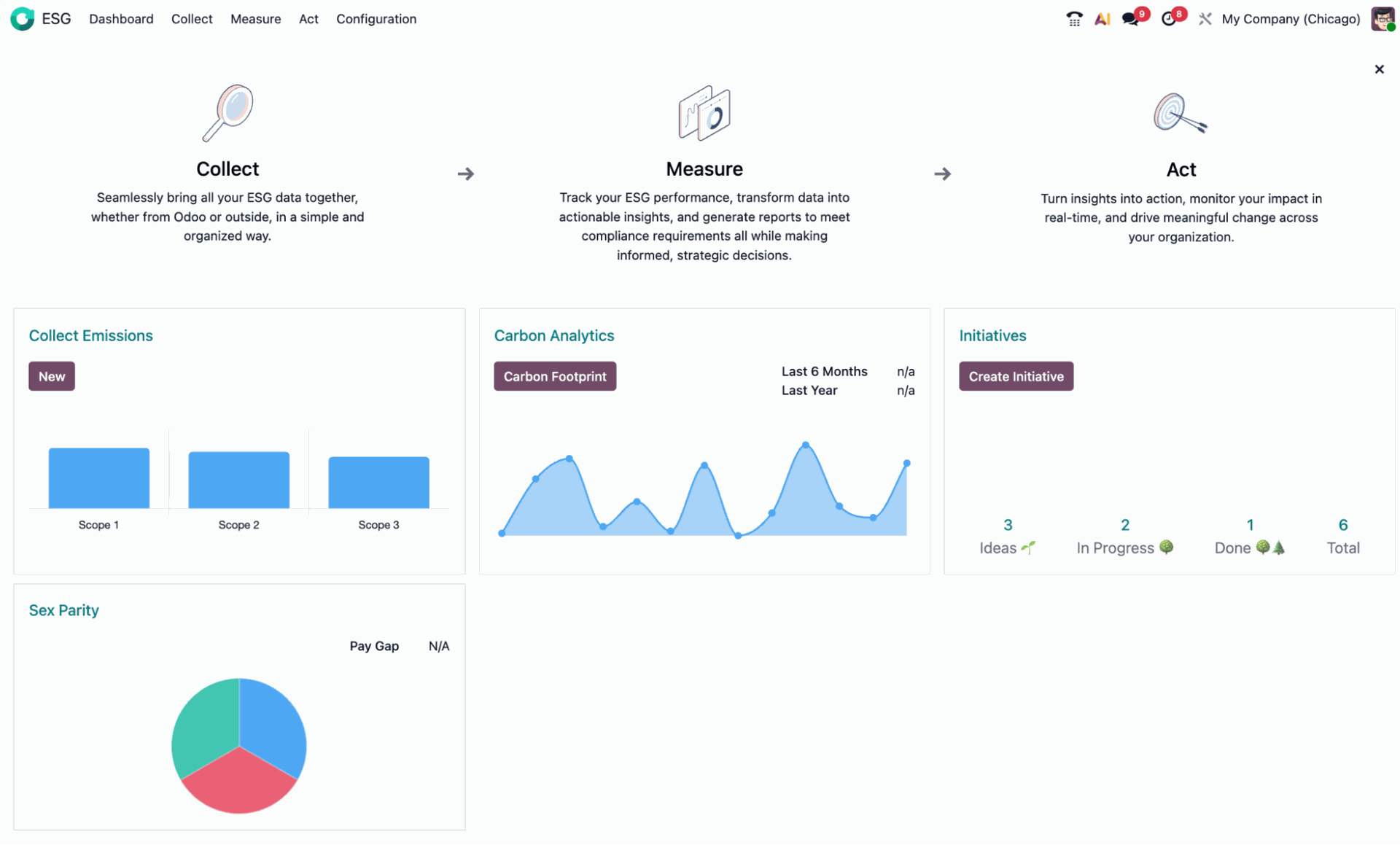
The struggle of reporting corporate sustainability
For the average company, ESG (Environmental, Social, and Governance) data is rarely in one place. It is usually scattered across the organisation:
- Accounting holds the fuel bills from the fleet operations.
- HR manages data on diversity and pay scales.
- Fleet management tracks mileage and carbon output.
Consolidating this into a formal report is a messy process. Still, as of 2025, the stakes for getting this right have further increased.
Under the EU’s CSRD, companies are now required to perform a "double materiality" assessment: reporting not just on how the environment impacts their business, but exactly how their operations impact the world.
With these regulations tightening annually, businesses can no longer rely on ad-hoc spreadsheets to keep up.
Odoo ESG turns compliance into a background process
Odoo 19 handles this by effectively tagging the data you already generate. Instead of waiting until the end of the year to gather records, the ESG app links to source documents as they are created.
This turns sustainability reporting into a continuous stream of information. By the time an auditor asks for data, it is simply a matter of exporting what has already been recorded.
The app pulls relevant figures - fuel costs, headcount, or mileage - and translates them into the metrics required for a compliance report.
Pillar | Odoo integration points | Metrics tracked |
Environment (E) |
Auto-calculates emissions, including fuel bills & utility invoices | Scope 1, 2, & 3 carbon footprint |
Social (S) |
Pulls data on gender pay gaps, diversity, and employee turnover | Gender parity ratio Employee wellbeing |
Governance (G) |
Tracks board certifications and policy adherence | Audit trails Policy compliance |
 Accounting
  Fleet
Fleet HR
HR Payroll
 Documents
  Sign
SignThe app meets compliance requirements by:
- Tracking emissions in real time with AI: CO₂ footprints across all operations are calculated automatically, and AI is used to assign verified emission factors
- Monitoring social metrics: Diversity, pay equity, and employee commuting data are tracked through HR and Payroll and integrated into ESG reports
- Automating reports & exports: Complex ESG reporting is handled directly in the system without external tools, and all ESG compliance data can be exported and shared in a single step.
As a result, ESG reporting is no longer a quarterly source of chaos but rather a no-headache part of your everyday operations.
Odoo monitors ESG initiatives & keeps you audit-ready with…
… Automated carbon emissions reporting
Odoo ESG automatically converts day-to-day operations into an accurate carbon footprint report.
- End-to-end carbon monitoring: Odoo ESG measures emissions from your company’s own operations, energy use, and the wider supply chain
- Emission factor mapping: Odoo integrates with international databases like ADEME or IPCC) to map purchase categories (like "Electricity") and automate CO2 calculations
- Verified AI-powered calculations: Odoo applies built-in, verified emission factors to your company’s operational data, like fuel, electricity, or expenses
- Audit-ready results: Every number links back to its source transaction, which means that audit data is reliable and compliance checks are always met.
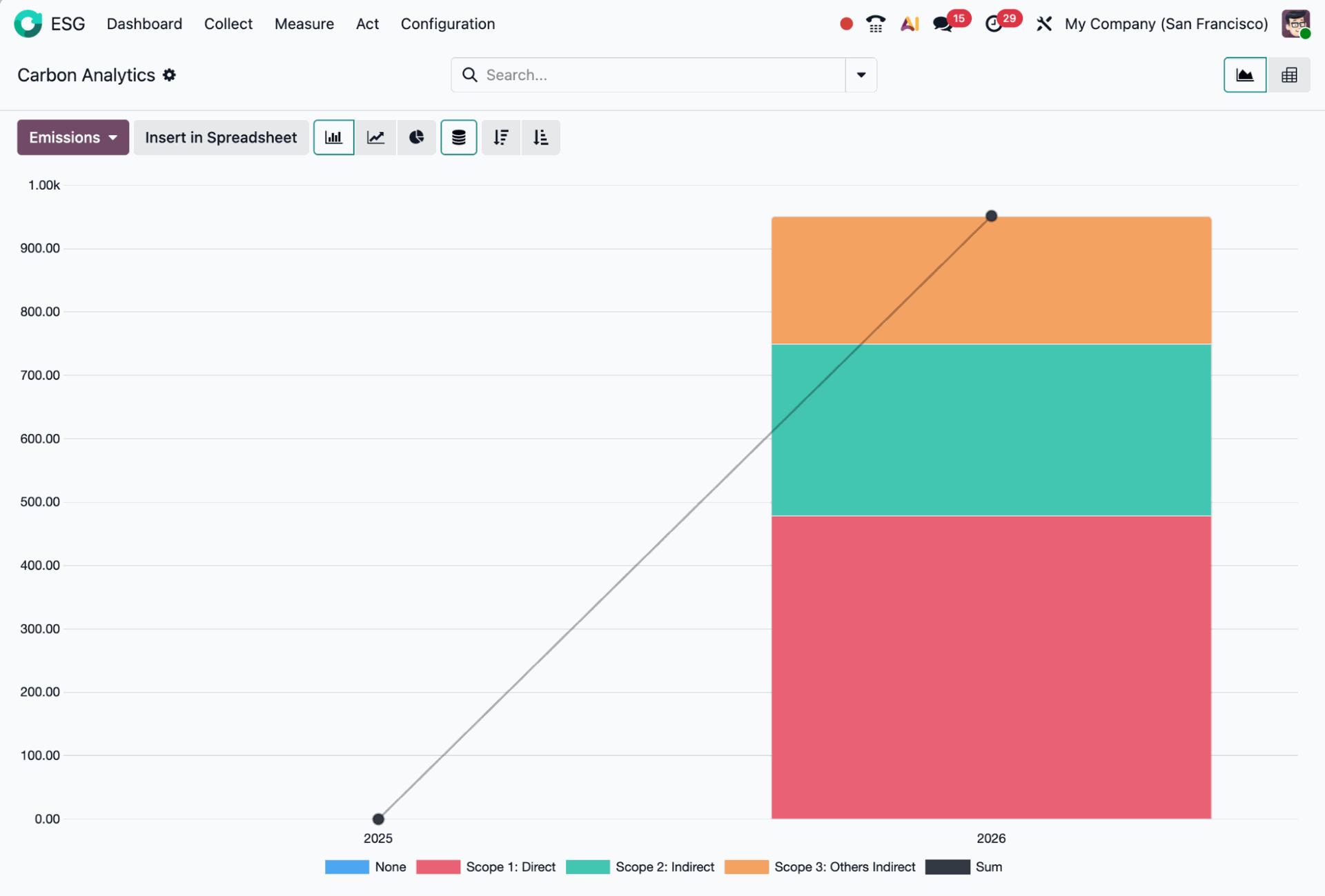
Carbon emissions tracked by Scope level in Odoo ESG.
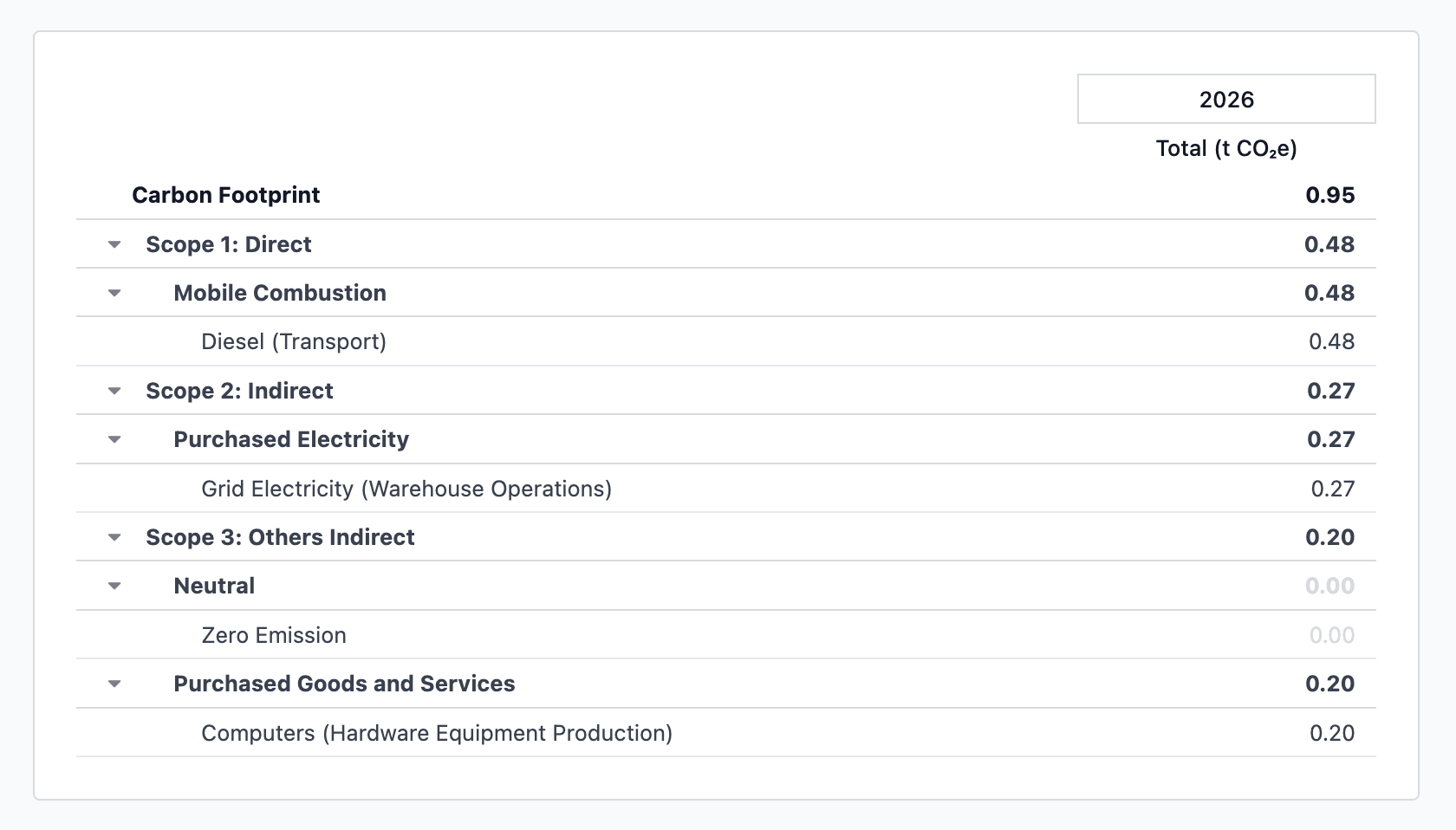
Automatically generated yearly carbon footprint report in Odoo ESG.
…Guided CSRD compliance and materiality assessment
For companies under the EU CSRD (Corporate Sustainability Reporting Directive) legislation, Odoo ESG simplifies reporting and ensures focus on material topics:
- Double materiality assessment (DMA): Evaluates both your company’s impact on the world and the world’s impact on your business
- Automatic reporting alignment: DMA results determine which ESRS (European Sustainability Reporting Standards) standards apply to your business
- Project-linked initiatives: Odoo ESG lets you connect material issues like waste reduction or energy efficiency to concrete projects & tasks, set targets, and track progress in real time.
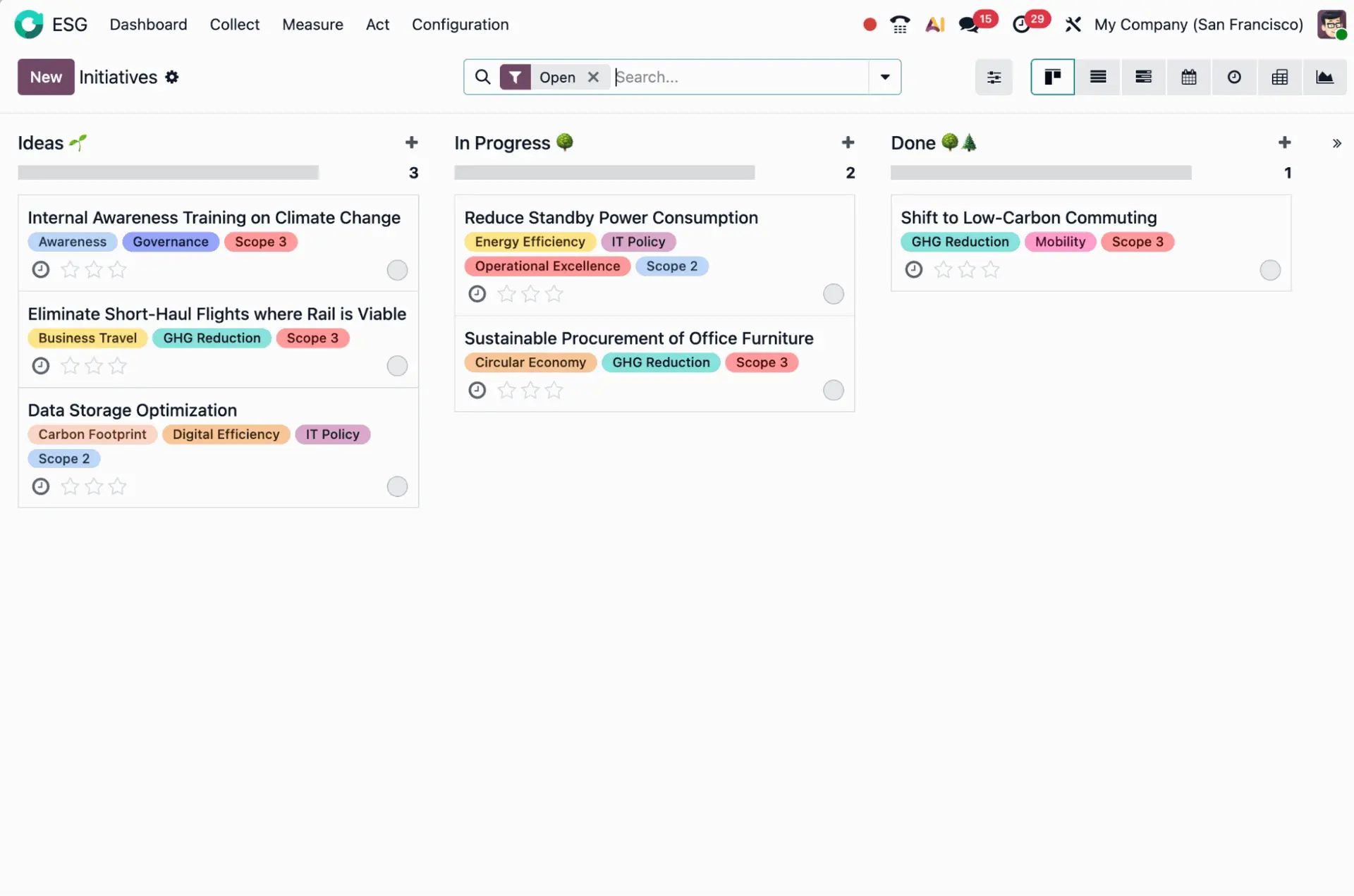
ESG initiatives Kanban in Odoo 19, to meet European sustainability standards.
…Integrated social impact metrics
Odoo ESG uses HR and Payroll data to monitor your social impact, providing transparency and actionable insights when it comes to your staff:
- Diversity and pay equity: Odoo ESG calculates gender parity across roles and visualises pay gaps across departments
- Employee well-being and commuting: Odoo measures the impact on employee health and carbon footprint from commuting.
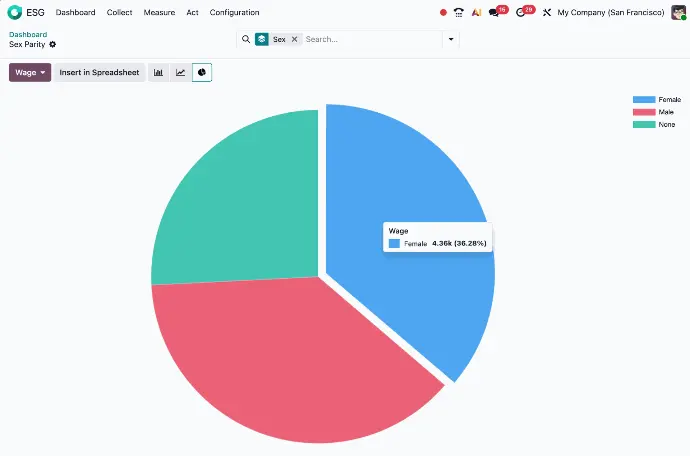
Gender-based wage distribution dashboard in Odoo ESG.
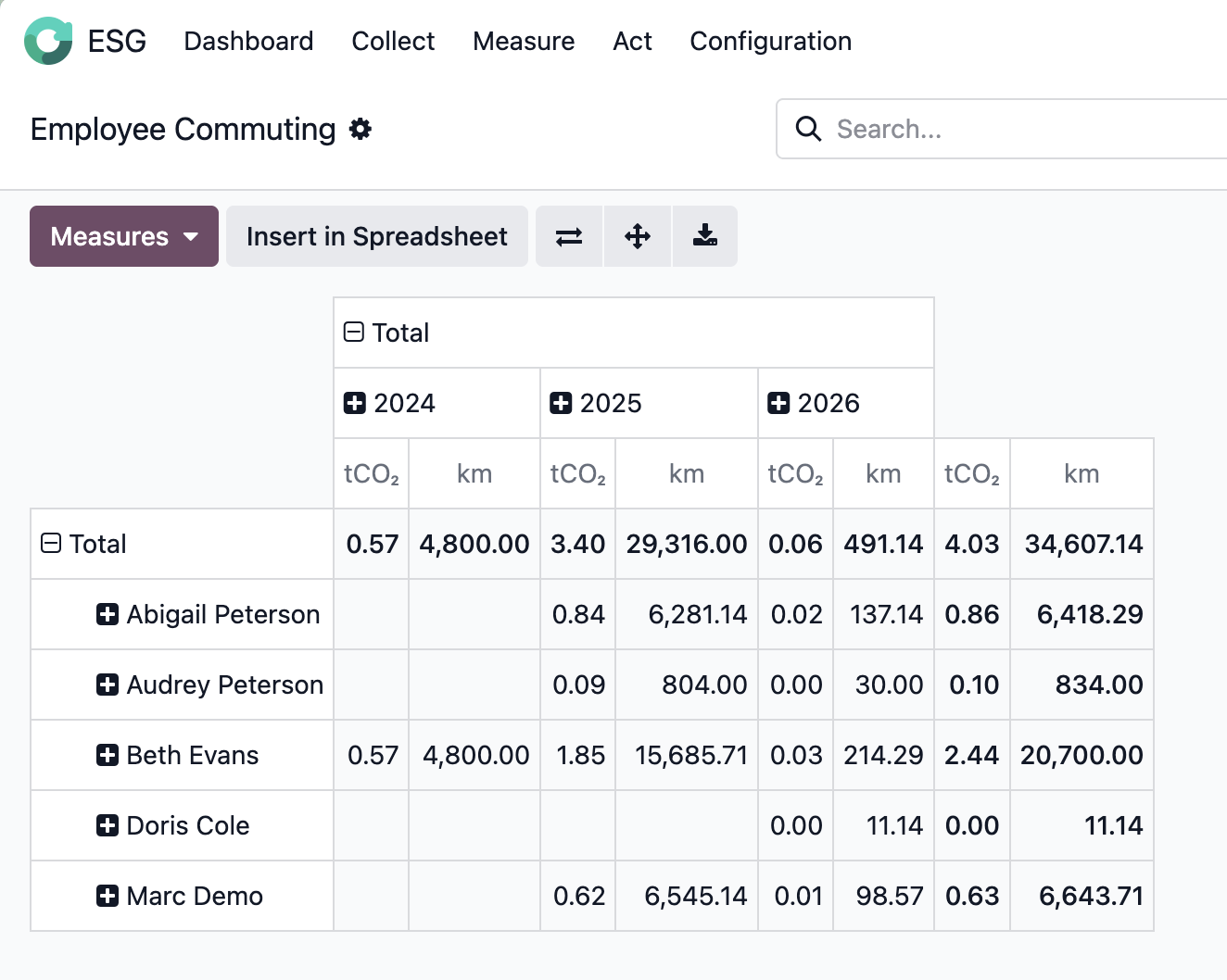
Emissions tracking based on employee commuting data in Odoo ESG.
Let’s discuss ESG reporting with Odoo
Our team of Odoo experts can help you meet sustainability measures and compliance with Odoo ESG.